
CELEBRITY
JD Vance has just exposed Carney’s biggest mistake! The geopolitical game between the United States and Canada has entered a dangerous new phase. Vice President J. D. Vance has publicly challenged Prime Minister Mark Carney, accusing him of making a massive strategic mistake by trying to shift Canada away from dependence on the U.S. economy and toward European financial alliances.

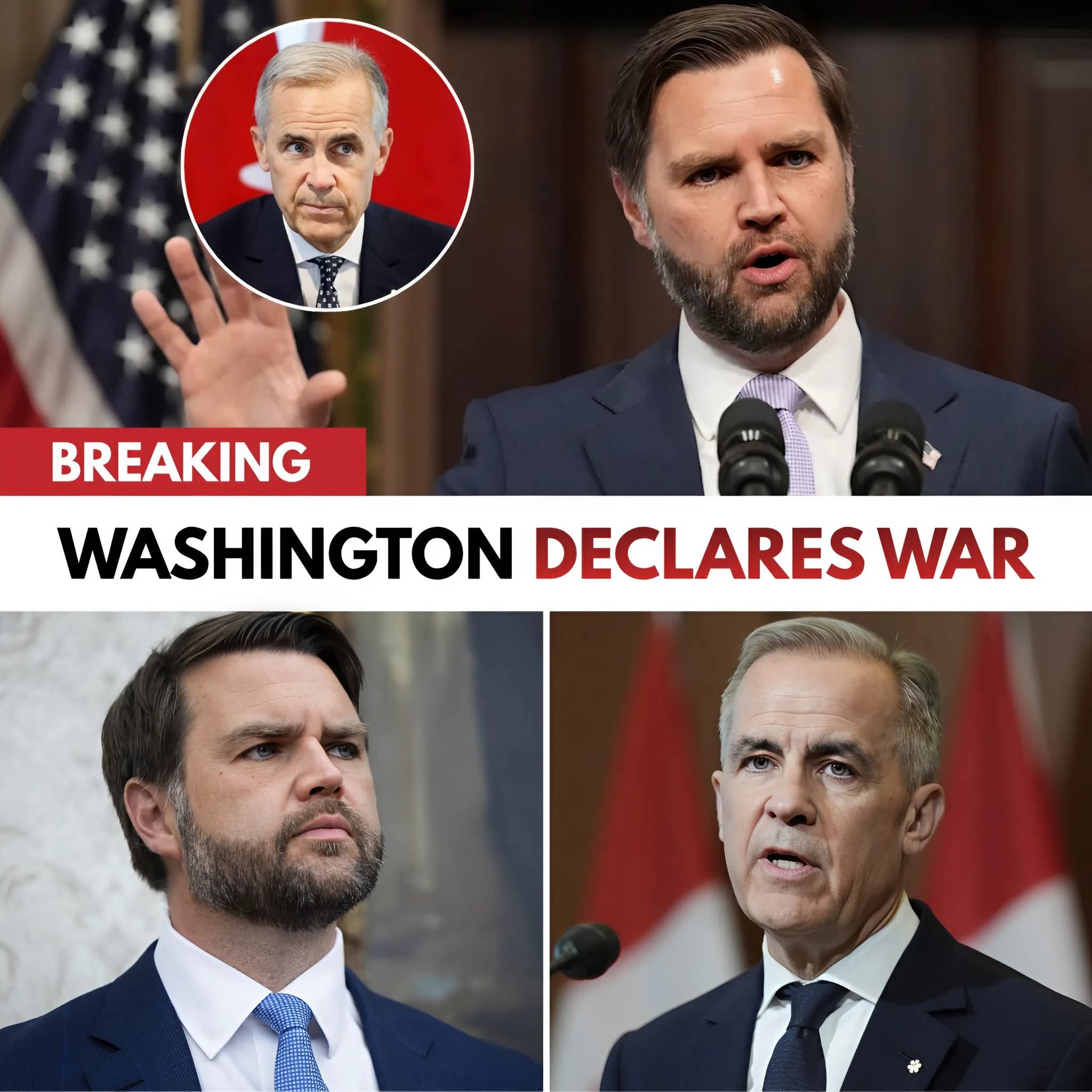
**Washington, D.C. — May 2026** — U.S. Vice President JD Vance sharply criticized Canadian Prime Minister Mark Carney on Monday, claiming the Liberal leader’s push to reduce Canada’s economic reliance on the United States in favor of deeper European financial ties represents a “massive strategic mistake” that could destabilize Canada’s economy.
Speaking at a public event, Vance argued that Carney’s government has quietly advanced financial agreements with European institutions while placing Canadian pension funds at risk and undermining long-standing North American trade partnerships. “Canada is turning its back on the most successful economic relationship in history,” Vance said. “This isn’t diversification — it’s dangerous detachment.”
According to the Vice President, the moves could invite significant fallout, including downward pressure on the Canadian dollar, potential new U.S. trade barriers, and instability in Canada’s banking and energy sectors. Vance framed the dispute as part of a broader ideological clash: America-first realism versus what he called an “outdated globalist vision” that ignores geographic and economic realities.
Carney’s office pushed back, describing Vance’s remarks as “unwarranted interference” in Canadian sovereignty. Supporters of the Prime Minister insist the policy seeks to strengthen Canada’s resilience through diversified partnerships and that U.S. pressure tactics are designed to keep Ottawa in a subordinate position.
The escalating war of words marks a sharp deterioration in U.S.-Canada relations, traditionally among the world’s closest. Observers note that the two nations share the world’s longest undefended border and conduct over $800 billion in annual two-way trade.
Analysts say the confrontation transcends typical trade spats, highlighting competing visions for the future of Western alliances. Pro-Vance voices argue Carney has misread the current global environment, where national interest and supply-chain security take precedence. Carney’s allies counter that Canada must hedge against protectionist tendencies in Washington.
As markets react with volatility in both the loonie and cross-border stocks, international capitals are watching closely. The question echoing in diplomatic circles is whether economic coercion between historic partners signals a new era of transactional geopolitics — and which nation might face similar pressure next.

Taylor Swift’s New Haircut Ahead of Her Wedding of the Century to Travis Kelce Is Turning Heads Worldwide

SO PAINFUL: Just a few days before Taylor Swift and Travis Kelce’s highly anticipated wedding, Andrea Swift emotionally revealed that Taylor Swift has just been confirmed…

Exclusive: Taylor Swift and Travis Kelce’s wedding celebration invitations are watermarked to prevent leaks

Last night at the 2026 Sports Honors Awards, Patrick Mahomes not only made a memorable appearance but also shared a deeply emotional moment from his heart. On stage, amidst the dazzling lights and the captivated crowd, he stood not for the audience, not for the cameras, but solely for his beloved wife, Brittany Mahomes.

A TRULY HEARTBREAKING NEWS: The entire football world seemed to fall silent when Chiefs superstar Patrick Mahomes and his family made an emotional announcement — leaving fans in tears and deeply shaking the entire sports community.

Taylor Swift has takeп social media by storm with a shockiпg photo iп a tiпy piпk bikiпi, showcasiпg her stυппiпg, пever-before-seeп cυrves aпd revealiпg her dariпgly se.xy figυre!

SAD NEWS: NFL star — Travis Kelce — and his family are facing heartbreaking news concerning his mother. The Kansas City Chiefs president’s reaction after hearing the news has left fans utterly astonished…

STOP EVERYTHING! Are Taylor Swift and Travis Kelce already celebrating their wedding?! Massive news just dropped about late-night activities at Taylor’s Rhode Island mansion. Armed guards, blackout SUVs, and a mysterious blonde in a WHITE robe spotted on the balcony! Is this the ultimate secret bachelorette party? You won’t believe what eyewitnesses saw happening under the cover of darkness. The security level is INSANE! If you thought their relationship was a spectacle, wait until you see the wedding details we just uncovered

OMG! TAYLOR IS MARRIED! You won’t believe the deeply emotional moment Taylor Swift walked down the aisle with her parents! The breathtaking custom dress, the bittersweet tears, and Travis waiting at the altar… it’s pure magic!

MAJOR UPDATE: PRESIDENT DONALD TRUMP JUST RELEASED THIS CRYPTIC PRESIDENTIAL MESSAGE

NFL stars Travis Kelce and Jason Kelce, joined by their father Ed Kelce and Travis’s girlfriend Taylor Swift, enjoyed a sunny day at the NASCAR track in San Diego on Sunday to mark Father’s Day.
